

Sales packs, binding contracts and digital conveyancing: a plain-English guide to what the Government’s proposed homebuying reforms mean for buyers and sellers.
Buying or selling a home should be one of the happiest moments in life. Too often, it is one of the most stressful. The average purchase currently takes around 120 days to complete, roughly one in three sales falls through, and failed transactions are estimated to cost sellers in the region of £400 million every year. If you have ever lost a sale at the last minute, or had a move fall through due to a broken chain, or watched the weeks tick by with no clear idea of what was holding things up, you will know exactly how that feels.
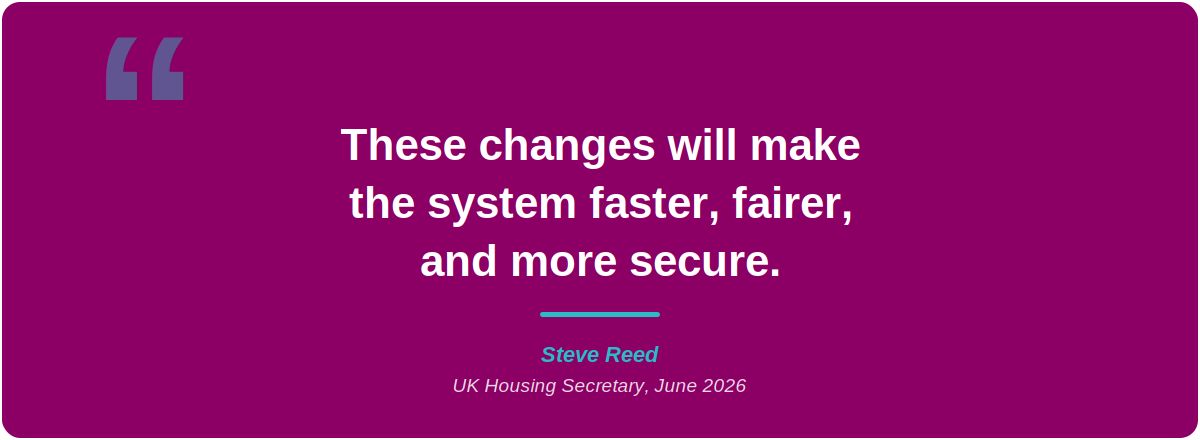
On Friday 19 June 2026, the Government set out a roadmap to fix it. The reforms aim to make moving home “faster, fairer, and more secure”, and while the headlines are encouraging, the detail matters. Here is what has actually been announced, when it is likely to happen, and what it means for you.
What has actually been announced?
This is a firm government commitment rather than a loose aspiration, with a clear plan and timetable behind it. For now, though, it remains a plan and is not yet law.
Upfront sales packs. Sellers and estate agents will be expected to provide key information at the point a property is listed, rather than weeks into a sale. These packs are intended to set out a home’s condition, any leasehold costs and its position in the chain, so buyers can make informed decisions from the outset and the professionals involved can get to work sooner.
Earlier binding agreements. The Government wants to introduce binding conditional contracts that commit both sides to the transaction much earlier, with a financial penalty if a party walks away without a valid reason. The intention is to reduce the number of deals that collapse months into the process, costing time and money on both sides.
Higher standards for estate agents. A new Code of Practice is planned to set minimum standards, alongside proposals for mandatory qualifications for the sector.
A shift to digital. Digital property logbooks, identity checks, electronic signatures and AI-assisted conveyancing are all part of the plan to cut duplication, reduce fraud risk and speed transactions up from start to finish.
The headline numbers
Three figures play a key part in the Government’s announcement:
• Buying times should be cut by around four weeks;
• First-time buyers are expected to save an average of £650;
• The ambition is to halve the number of sales that fall through.
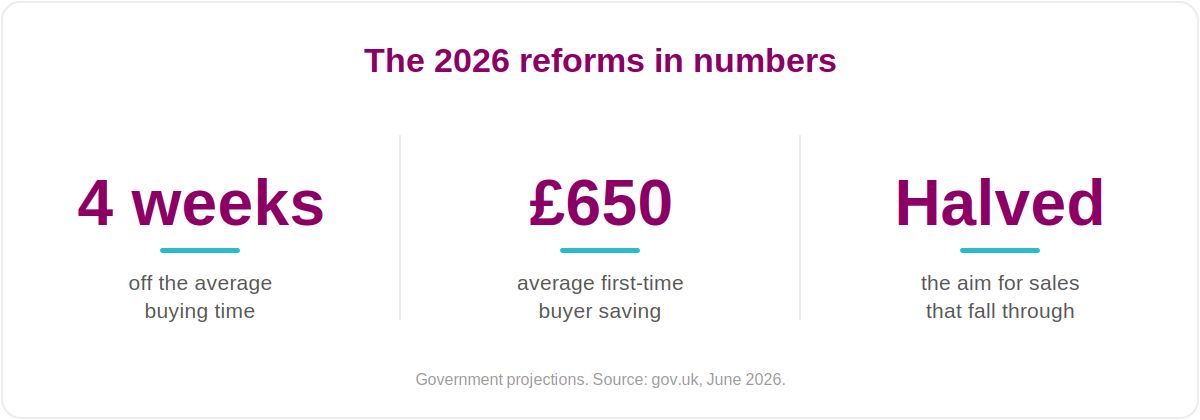
These figures are genuinely worth getting excited about. It is only fair to add, though, that they are Government projections of what the reforms could deliver once fully in place, rather than savings you can count on today. We would rather be honest with you about that than repeat the numbers as if they were guaranteed.
So when is all this happening?
This is the part that many summaries skip, though it is the part that matters most if you are planning a move. These reforms are being introduced in phases across the rest of this current Parliament:
• Later in 2026: introduction of a Code of Practice for property agents, plus guidance to improve the quality of information in property listings.
• From 2027: a consultation on estate agent qualifications to support their increased use of digital tools.
• By the end of this Parliament (2029): comprehensive legislation to require sales packs, binding contracts and the digital systems that allow trusted property information to be shared securely.
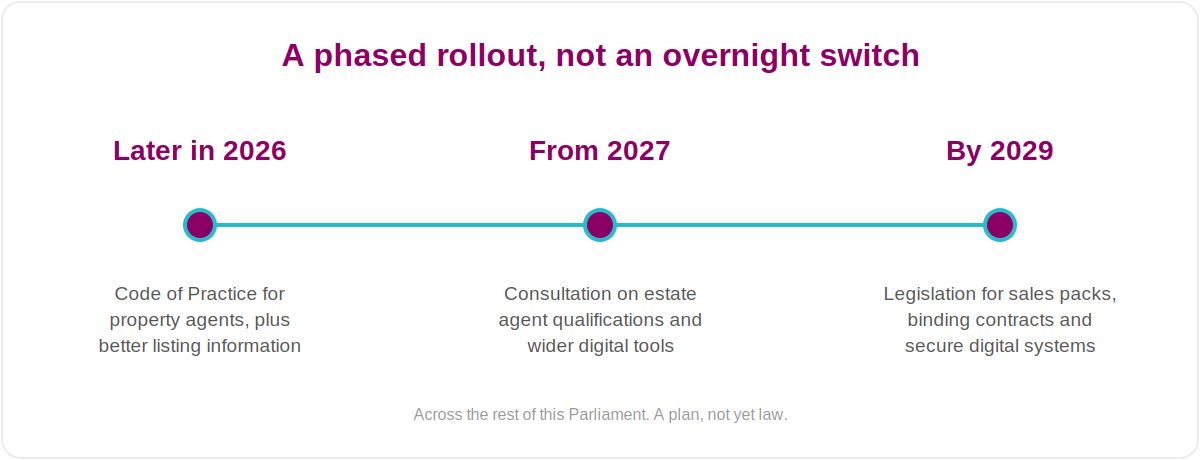
In other words, this is a direction of travel rather than a switch being turned on overnight.
The Government has also confirmed that binding contracts will not come into force until sales packs are properly embedded, so buyers will not find themselves committed to a purchase before they have crucial information about the property they intend to buy. That is a sensible safeguard.
The practical takeaway: if you are ready to move now, there is no reason to wait for these reforms. The current process still works, and good advice still makes all the difference.
What it means if you are buying
If you are buying, more information upfront should mean fewer nasty surprises late in the day, and earlier certainty that the seller is committed. The flip side is that binding contracts cut both ways.
If you are committed to your purchase earlier on, you need to be confident in your decision before you sign any contract, which makes early, clear legal advice more important, not less.
What it means if you are selling
If you are selling, timely preparation becomes the name of the game. Getting your documentation ready early, rather than scrambling for it once an offer comes in, is likely to become the norm. The good news is that these reforms are designed so that you will not be locked into a sale before your buyer has seen the essential property information pack, keeping the process fair on both sides.
What it means for all sides
There is a welcome Brucie-bonus for everyone in the chain, not just the people at either end of a single sale. Because more deals hold together, the all-too-familiar nightmare of a chain break, where one sale falling through brings down everyone above and below it, should become far rarer. For any one of the countless people who has lost a home that way, that alone may be the most welcome change of all.
Where Cunningtons fits in
We are already ahead of the curve on one of these reforms. We were early adopters of Property Logbooks, and we encourage our buyer clients to use them, so the key documents affecting their home are always easily available. Your property logbook also grows with you throughout your ownership, giving you one place to keep guarantees, certificates for alterations and other paperwork you will be glad to have when it is time to sell. A firm founded in 1748, championing digital logbooks in 2026: we have always believed in moving with the times, even when the times move this fast!
The Law Society has also welcomed these changes, noting that property solicitors play a central role in buying and selling and are well-placed to judge how these proposals will work in practice. We would agree, and we have a longer view than most: Cunningtons has been guiding people through property transactions for more than 275 years. We have seen the system change before, and we are ready for what comes next.
Much of what these reforms aim to achieve, clear information shared early and transparent costs with no nasty surprises, is how we prefer to work already. Our conveyancing teams act for buyers and sellers across all seven of our branches, in Braintree, Brighton, Chelmsford, Croydon, Hastings, Hornchurch and Wickford, and we are happy to explain the process as it stands today and keep you updated as these changes roll out.
We also know that the very first question most people have is a simple one: how much will this cost? That is why we aim to provide you with a clear and fixed conveyancing quotation within 24 working hours of you asking for one.
Our honest take
It is worth noting that the property industry’s response, from bodies including the Law Society, RICS and the trade associations, has been broadly positive but consistently cautious on one point: how the reforms are implemented and phased will determine whether they succeed. We share that view. The ambition is the right one, and we will be following the detail closely so that our clients always have an accurate picture rather than the headline version.
There is also a practical reality to flag up. A change of this scale will call for significant retraining across the property industry, particularly for those who are less comfortable with digital ways of working, and that transition will take both time and investment. On the brighter side, it could also create fresh opportunities and new roles for a younger, more tech-confident generation coming into the profession.
Thinking about your move?
Whether you are buying your first home, selling, or simply starting to plan ahead, our conveyancing team is here to talk you through your options today and to keep you informed as the reforms take shape.
To get started, ask for your free conveyancing quotation and we’ll get back to you within 24 working hours.