
Summary
The duties of an executor can be onerous, and you might not be in the right frame of mind to properly administer a loved one's Will. We go through the areas that an executor has to cover: lifetime gifts, advertising for beneficiaries and creditors, Will searches, determining digital assets, genealogy, and Section 160 Valuations.
Have you been named as the executor of someone’s Will, but you’re not sure what you actually have to do? As an executor you are legally responsible for dealing with a deceased person’s estate and carrying out their wishes as set out in their Will.
It can be a demanding job, with its own jargon and real responsibilities, and if you make mistakes you can even be held personally liable for them. This guide explains what the role of an executor involves, step by step, and where you can get help if you need it.
What does an executor actually do?
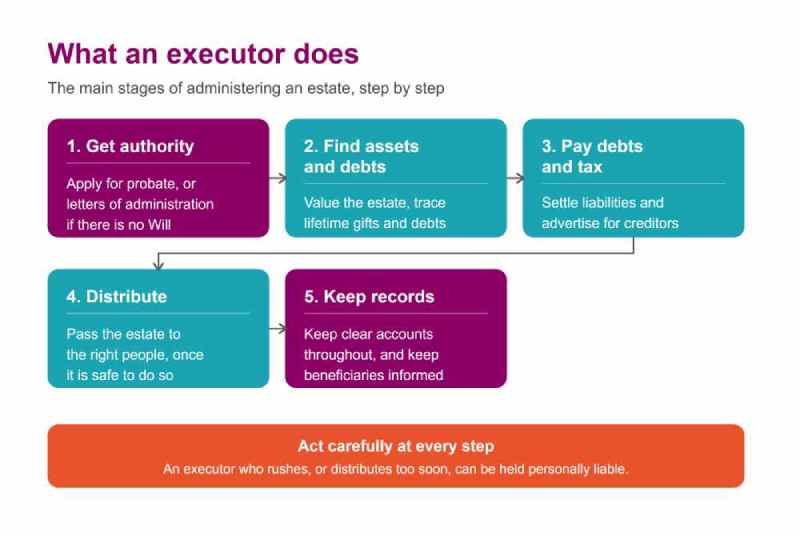
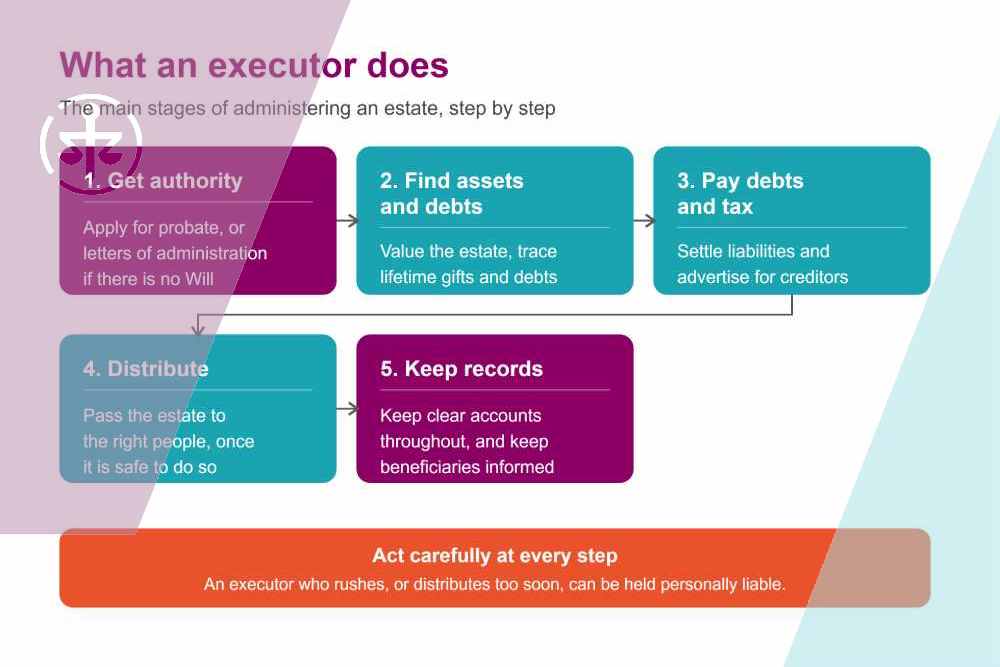
Before you can act, you usually need legal authority: a Grant of Probate or Letters of Administration if there is no Will (in which case you are an ‘administrator’ rather than an executor). Once you have that, your main tasks include:
- registering the death;
- arranging the funeral;
- valuing the estate;
- paying any inheritance tax;
- applying for probate;
- sorting the deceased’s finances;
- placing a deceased estates notice;
- distributing the estate; and
- keeping estate accounts.
Throughout, you must keep beneficiaries informed, maintain accurate records, and act in good faith at all times. It is important that you act carefully, and get help if you are unsure.
Determining what the deceased owned – and owed
As executor, your first task is to ascertain the assets and liabilities in the deceased’s estate. This may involve contacting organisations where the deceased held assets, such as banks and building societies, and contacting any creditors the deceased owed money to.
You will need to collect in the estate funds, that is, gather in bank account balances, sell shares, cash in Premium Bonds and so on, and pay any liabilities and estate administration expenses.
An executor is also responsible for dealing with the deceased’s financial liabilities. This includes the income tax position of the deceased from the date of death to the end of the administration period, as well as any capital gains tax liability on the disposal of assets.
If there was an inheritance tax liability, it is important too that the executors seek confirmation from HMRC that there are no further enquiries and that the position is settled.
Depending on the value of the estate and who the assets pass to, you may have to report the estate to HMRC for inheritance tax purposes. As inheritance tax is based on the value of the estate at the date of death, and that information must also be submitted to the court, the first task will be to ascertain and value the deceased’s assets and liabilities. The executor will therefore have to deal with several different organisations and professional valuers to gather this information together, and must also assess what exemptions and reliefs apply in calculating the final inheritance tax liability.
As executor, you are responsible for preserving and protecting the assets. This includes property, and in consequence you will be responsible for ensuring that insurers have been notified.
Determining lifetime gifts
As executor to an estate, HMRC will place a duty upon you to make reasonable enquiries as to whether any gifts have been made within 7 years of the date of death. This is to ensure that, where necessary, gifts have been accounted for in the tax return that a personal representative will be required (in some cases) to submit to HMRC to apply for the Grant of Probate.
Given the Government’s clampdown on tax avoidance, HMRC are likely to be unsympathetic if you fail to make reasonable enquiries in relation to gifts, and could levy substantial penalties upon you personally, whether or not any inheritance tax needs to be paid from the estate. Any penalties would fall upon you personally as the personal representative or executor, rather than upon the estate’s assets.
It is therefore recommended that you make enquiries with family members, friends, people named in the Will (if there is a Will in place), Solicitors, Accountants and Financial Advisers and keep a record of the enquiries that you have made and the responses that you have received.
It is also recommended that you obtain and review 7 years of bank statements for all accounts and make enquiries with the bank about any payments over £250 which are either unreferenced or you suspect might have been a gift.
Gifts take many forms and can sometimes be something we would not consider a gift.
Examples of gifts include:
- any transfer of assets to or for the benefit of another person, charity, organisation and/or trust fund;
- any trust created during the lifetime of a deceased person and/or any trust which the deceased brought to an end during their lifetime;
- any contributions made by the deceased to purchase assets for another person, charity, organisation and/or trust fund; or
- any premiums paid on a life policy for the benefit of another person.
Advertising to find beneficiaries and creditors
Personal representatives and executors are under a duty to pay all debts of the deceased, whether or not they are aware of them. Even if you have otherwise acted in good faith when distributing assets to beneficiaries, as a personal representative you remain potentially personally liable to creditors who have not been paid.
A personal representative may therefore be concerned that, after the distribution of an estate has taken place, a previously unknown creditor comes forward claiming that the personal representative must make good any unpaid debts personally.
There is statutory protection available to you. As a personal representative, you can advertise in the London Gazette (and in a local newspaper where the deceased held any land) giving notice of your intention to distribute the estate, and asking anyone who believes they are owed money from the estate to come forward within two months of the date of the advertisements. This protects a personal representative from claims by creditors they were reasonably unaware of.
The adverts do not protect beneficiaries of an estate against such claims.
Placing adverts may also encourage any beneficiaries whose whereabouts are unknown to come forward.
It is advisable that you place these adverts in order to account to HMRC properly for the value of the estate, and to show that you have made reasonable enquiries to establish the gross and net values of the estate.
Conducting a Will search
The Law Society recommends that a Will search is carried out to look for any registered or unregistered Wills.
A Will search offers personal representatives protection against administering the estate incorrectly, by assuming either that there is no Will in place, or that the Will they have sight of is the deceased’s most recent one.
Finding financial assets and digital assets
Personal representatives are under a duty to identify all assets within a deceased person’s estate, and may be unaware from the deceased’s paperwork of any forgotten or unknown assets.
This is particularly true of digital assets, such as PayPal accounts, which are often unknown to a personal representative.
It may therefore be advisable that you carry out a Financial Assets Search, and to search bank statements for evidence of any payments to online providers, or entries showing the purchase or sale of Bitcoin or other digital assets.
Read our article about digital assets for more information on this.
Genealogy – getting the Family Tree right
Personal representatives have a duty to distribute an estate in accordance with the law. Where a person dies without a Will, or there is a Will in place that provides for a class gift such as “to all my nieces and nephews”, there is a risk to personal representatives. If the executors are deemed to have distributed the estate incorrectly, there could be a claim against the estate which could render them personally financially liable for any mistakes they have made.
Family relationships can be complex, and often not as they first appear, so it is advisable that research is carried out by a genealogist to construct a family tree, so that the executors can identify everyone entitled.
Determining Section 160 valuations
Personal Representatives and Executors are under a duty to account to HMRC properly for the value of a deceased person’s estate at the time of their death. HMRC requires that any property be valued in accordance with a Statutory definition referred to as a Section 160 valuation. This is:
The price which the property might reasonably be expected to fetch if sold in the open market at that time; but this price shall not be assumed to be reduced on the grounds that the whole property is to be placed on the market at one and the same time.
It is recommended that a surveyor is instructed to prepare a written valuation report of the value of any Land in accordance with Section 160 to ascertain the open market value of any Land as at the date of death. The surveyor should be asked to assess whether there is any development potential which is commonly referred to as ‘hope’ value.
Similarly, if there are any personal items of any value in the estate, it is recommended that a suitably-qualified valuer be asked to prepare a written report of the value of each personal item in accordance with Section 160.
It will be important to ask family and friends whether any personal items have been loaned out to them or are being kept on behalf of the deceased so that they are being kept securely to ascertain the full extent of the personal items in the estate.
Can an executor be held personally liable?
Yes, executors can also face a claim. The main risk you face is if you distribute the estate too soon: if you pay out before debts, taxes or possible claims are resolved, you can be left personally responsible for any shortfall. You can also be liable if you distribute assets to the wrong people, or fail to make the enquiries HMRC expects.
Most executors have nothing to fear. The law knows that you are not a paid professional, so an executor who behaves honestly, keeps good records, and asks for advice when they are unsure is well-protected. Risks only arise if you act hastily, even when beneficiaries are pressing you to, or if you press on alone when you are out of your depth.
Help with Wills and Probate
If the thought of having to run a section 160 valuation of property belonging to a dead loved one fills you with dread, or you shudder at the prospect of building an accurate family tree to find beneficiaries, we can help.
The Cunningtons Wills and Probate team have plenty of experience when it comes to dealing with probate and administering a Will. Contact us for guidance at this difficult time.
Visit our branches for more information: Braintree, Brighton, Chelmsford, Croydon, Hastings, Hornchurch and Wickford.