

When you sell a property, do you have to tell the buyer about its problems?
For the most part, no. The guiding principle is “buyer beware”, or caveat emptor, and it is up to the buyer to investigate what they are taking on.
But there is one important exception. If you know about a hidden defect in the title, meaning something the buyer could not discover for themselves, the law requires you to disclose it. Get that wrong, and you could face a claim for breach of contract or misrepresentation, even where the buyer might in theory have found the problem.
So the seller doesn’t have to tell me anything?
It’s important to understand what the ‘hidden defect in the title’ exception means, because it turns on what the law calls a ‘latent title defect’.
When you sell property, the snappily entitled Law of Property (Miscellaneous Provisions) Act 1994 implies certain things into the agreement between you and the buyer.
Among other important things, these implied terms include what is effectively a promise that the seller is selling the property free from all charges, encumbrances and rights exercisable by third parties which the seller could not reasonably know about; these are otherwise known as ‘latent title defects’.
Whilst a breach of this title guarantee is not automatically a misrepresentation – but it can be, it will always be a breach of contract if a title guarantee is given by the seller, which it always is (if a solicitor is going to advise their buyer client to purchase a property without a title guarantee, this would be nothing but negligent).
What’s a latent title defect again?
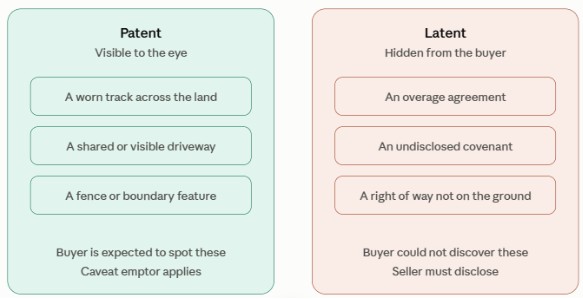
In plain English, a latent title defect is a right that a third party has to use the land or property in some way, and which cannot be discovered just by looking at the relevant paperwork or from an inspection of the land. It is a right which a buyer could not discover, which means if the seller knows about it, the seller must disclose it.
Latent title defects could include:
- rights of way,
- a right to take something from the land,
- restrictions or restrictive covenants which do not appear in the paperwork, or
- what are called ‘overage agreements’, requiring a payment to a third party (normally the owner that created the overage), when the property or land is sold.
There are questions in the TA6 – Property Information Form (the latest edition at the time of this article being the 2025 6th edition) which are aimed at identifying latent title defects, such as the questions in section 9, which ask about rights and informal arrangements.
However, a seller would be well advised to make sure that they disclose anything which might be a right exercisable over their property, even if it is potentially discoverable.
If the buyer can discover it for themselves, why should I draw attention to it?
In the very old case of Yandle and Sons v Sutton [1922] 2 Ch 199, which remains good law, the seller agreed to sell a field to a buyer. There was a public right of way over the field, which was arguably identifiable from a track and was represented by a dotted line on an Ordnance Survey map (although this was qualified to the extent that the map stated that this was not proof there was a right of way).
Despite the argument that a reasonably prudent buyer should have made an enquiry from these facts, and should have been able to identify the right of way, and it was not, therefore, a latent title defect as it was discoverable, the Court felt differently. In conclusion, the judge noted that:
Put another way, whilst there may have been a track, it was not clear from this alone that it was because there was a public right of way; the seller should have disclosed this.
In the far more recent case of SPS Groundworks and Building Ltd v Mahil [2022] EWHC 371 (QB), a similar point arose.
In that case, the Court held that just because prospective buyers were asked to read the auction brochure and legal pack (which the buyers didn’t!), which would have revealed the existence of a restriction (but not the underlying overage agreement in respect of it), this was not sufficient for a seller to have complied with its duty to disclose defects in title, and the overage agreement was a defect in title.
The misrepresentation in this matter arose from the fact that the seller could not reasonably have believed that, with the presence of the overage, the land had “excellent scope for development” and was “a superb investment opportunity”.
In conclusion: you can’t ignore latent title defects
If a seller knows that a third party has been using their land, or has acquired rights over it, it is vital for the seller to disclose this to the prospective buyer.
It is clear from case law above that just because the buyer might be able to discover it for themselves, or indeed were given the means to discover it, it does not automatically follow that this alleviates the seller from the duty to disclose latent title defects. At best, it would lead to costly litigation about whether or not the defect was ‘patent’ or ‘latent’, which is also not always that easy to establish.
If a seller fails to comply with this duty of disclosure, they may very well find themselves defending a claim for breach of contract and/or misrepresentation.
What do I do now?
Whether you are selling and want to be sure that you have met your obligations, or if you have bought a property and discovered a right or restriction nobody told you about, the sooner you take advice on the matter, the better.
In duty of disclosure disputes, detail is key: as you can see, issues like what the seller knew, what the buyer could realistically have discovered, and if the defect was patent or latent (see the chart above) are what matters. And getting a clear idea of where you stand early on in proceedings is often what keeps a problem out of court.
How Cunningtons’ litigation team can help
Our property litigation team acts for buyers and sellers across all our branches, and can tell you honestly whether you have a claim worth pursuing, or a duty you need to take seriously.
Contact us for a quotation and we will come back to you within 24 working hours.
If you would rather talk it through first, contact litigation partner Mark Taylor.