
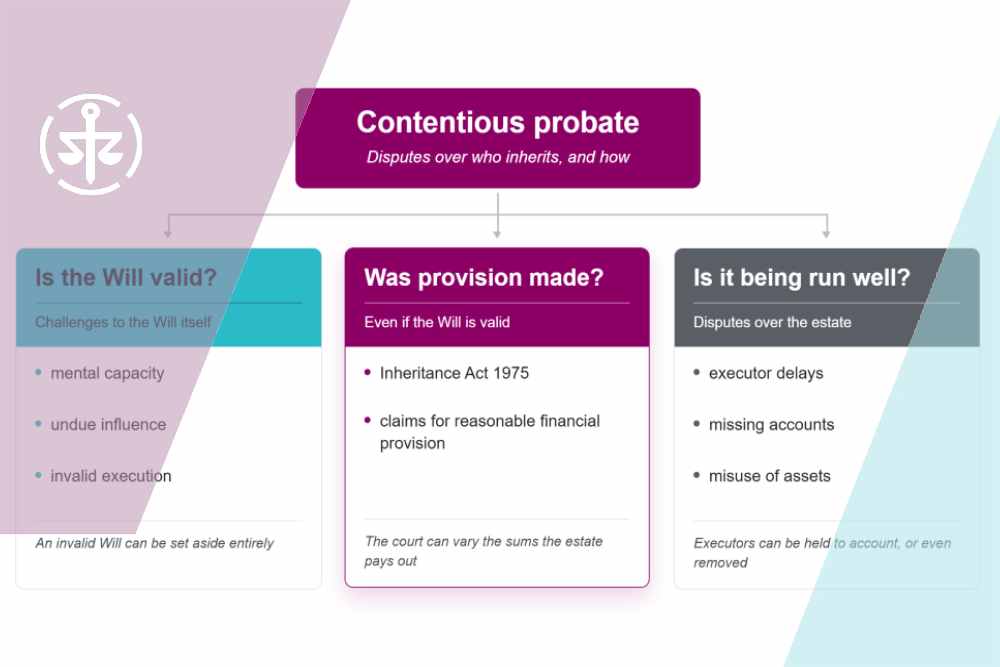
Have you been left out of a Will, cut out of an estate, or shut out by an executor who will not explain what is happening to your inheritance? “Contentious probate” is the umbrella term for disputes like these, over who inherits and how an estate is handled. You cannot challenge a Will just because you are unhappy with it, but there are specific circumstances in which a Will, or the way an estate is being administered, can be contested.
What is Contentious Probate?
Contentious probate covers disputes about Wills, trusts, inheritance, and how an estate is being administered or distributed. A Will or an administration can only be contested in specific circumstances. Examples include:
- a challenge to the validity of a Will;
- being unexpectedly excluded from a Will, or receiving less than expected;
- disputes between siblings or family members over inheritance;
- executors delaying administration;
- failure to provide estate accounts;
- suspected misuse of estate funds;
- assets being distributed without proper explanation;
- applications to remove or replace executors;
- trustees failing to act impartially;
- concerns that estate assets have been undervalued; and
- allegations of breach of trust.
Contesting the validity of a Will
You cannot simply contest a Will because you are unhappy with your share – that is a myth created by television drama. There must be a specific legal basis for any contentious probate claim.
The question is not whether the Will is fair, but whether it is valid.
The main grounds for contesting a Will are:
- Lack of mental capacity – the person must have understood the nature and effect of the Will, the extent of their estate, and how it was to be administered. If they did not, the Will may be invalid;
- Undue influence or suspicious circumstances – if someone pressured or manipulated the person into making or changing a Will, the court may not uphold it. Significant last-minute changes, secrecy, or unusual involvement by third parties can raise legitimate concerns; or
- Issues with signing or witnessing, known as ‘invalid execution’ – a Will must follow strict formalities. Mistakes in execution can cause it to fail.
The golden rule when contesting a Will is to act fast. The usual first step is to enter a caveat with the Probate Registry, which prevents the estate being distributed while the dispute is investigated. This matters, because a claim under the Inheritance Act 1975 must usually be brought within six months of the grant of probate.
Inheritance Act claims and estate disputes
An inheritance dispute is a disagreement over how a deceased person’s estate (meaning their money, property and possessions) is divided between beneficiaries of their Will. Most fall into one of three categories: Inheritance Act claims; intestacy disputes; and executor disputes.
Even where a Will is valid, certain people can bring a claim under the Inheritance (Provision for Family and Dependants) Act 1975 if they believe that they have not been left with reasonable financial provision.
Those who may claim include:
- a spouse or civil partner;
- a former spouse or civil partner who has not remarried;
- a cohabiting partner of at least two years;
- a child of the deceased, whether a minor or an adult;
- anyone treated as a child of the family, where the deceased stood in the role of a parent, such as a stepchild; or
- anyone who was being financially maintained by the deceased.
Following the Rules of Intestacy
When someone dies with no valid Will, their estate is shared out according to the rules of intestacy. These rules list the fixed legal order of who inherits and how much they can expect.
Intestacy disputes can arise when someone believes they should have been provided for, but the intestacy rules leave them with nothing, or too little, or when there is disagreement over who qualifies. A common and painful misconception is that a long-term cohabiting partner will automatically inherit; in fact they currently have no automatic right under the intestacy rules, however long the relationship.
Executor disputes
Not every inheritance dispute is about the Will. Disputes also arise over how an estate is being administered.
Common issues include:
- poor communication from executors;
- delays in collecting or distributing assets;
- concerns about valuations;
- lack of transparency over accounts; or
- potential conflicts of interest.
Executors have clear duties, and beneficiaries are entitled to expect an estate to be administered properly and without unreasonable delay.
A reality check
Contentious probate is an emotive area, and emotion often drives these disputes. It is worth remembering that a court battle can be very expensive and can quickly swallow the value of the estate itself.
That is why it pays to take advice early, so a dispute can be handled calmly and cost-effectively. Many cases are resolved without going to court, through negotiation or mediation, and we can act for you as claimant or defendant throughout.
How Cunningtons can help
Our litigation team has significant experience advising both beneficiaries and executors in these matters. Whether you are considering bringing a claim or having to defend one, we can help you understand your position and the options available to you.
To discuss a possible claim, email Sean Kirk directly, or send your enquiry to quotes@cunningtons.co.uk and it will be passed to him.
We will come back to you within 24 working hours, explaining clearly how we charge for this type of work and giving you a clear picture of the likely costs before you commit to anything.